What's New
Lessons in virtue from two great warriors (Vancouver Sun - May 11, 2008) Huynh maintains Sun Tzu's pragmatic philosophy can prevent conflicts, quickly resolve them if they do arise, promote benevolence in adversarial situations, convert potential enemies into friends and help individuals control their emotions. The latter leads to one of the most striking philosophical parallels between the two warriors.
Sonshi Art of War Book Club (April 25, 2008) When you sign up for the Sonshi Art of War Book Club, you'll receive the latest news and updates on "The Art of War--Spirituality for Conflict." And if you live in the Atlanta area, you'll also receive information about Art of War discussion meetings with author Thomas Huynh at his favorite restaurant, Mint's Grill located in Tucker, Georgia (corner of Jimmy Carter Blvd and Lawrenceville Hwy).
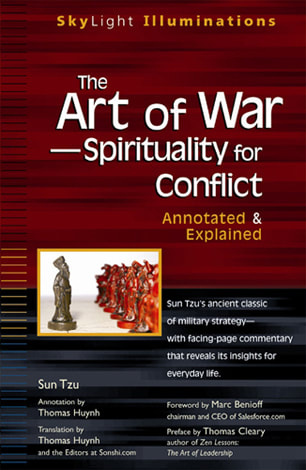
Conversation with author Thomas Huynh - Georgia Asian Times (April 20, 2008) Author Thomas Huynh sat down with the Georgia Asian Times to discuss his new book, "The Art of War--Spirituality for Conflict." Learn more about the book, the author, and his philosophy, which unsurprisingly is heavily influenced by Sun Tzu.

Discussion Topics
The virtues of the commander (highlighted May 11, 2008) I have decided to post on one of my favorite Japanese dialogs that sound as though it was inspired by Sunzi, as well as other Chinese strategic dialogs. No other nation outside of China quite took so well to the Sunzi Bingfa as Japan.
Best Practices of World Class Strategists (highlighted April 27, 2008) One of my favorite ["best practices"] is reading Sunzo AoW while standing or listening to Sz's AoW while doing grunt and grind work. As this CARDINAL was reading, he recalled that many good strategic thinkers and world class achievers did some of their best work, using standing tables. Would someone like to continue w/ this thread w/ other best practices? Using rewards and Punishments do not work (highlighted April 17, 2008) Unless the "golden rule" is applied. We do unto others but do we do unto our self? One who Disiplines themselves is praised and is successful. One who punish themselves are masochist and have mental problems. We disipline ourselves but punish others. The only rule we apply is the Fool's Golden Rule.
Sun Tzu in the News
Carphone's ring-tone, Currys' death-knell (Daily
Telegraph - May 10, 2008) It was the Chinese scribe Sun Tzu who, in the sixth century BC, wrote The Art of War, a treatise that became one of the foremost manuals on military strategy. I can't think of much better weekend reading for John Browett, the chief executive of the company you and I used to know as Dixons.
John McCain and the Art of War (The Star-Ledger - April 27, 2008) McCain's specialty is supposed to be military affairs. As late as 1996, he authored a serious paper on the subject of military readiness for the 21st century. Yet now that the 21st century has arrived, he seems to have re gressed to the point that he no longer recognizes principles of war that were already known in the 6th century B.C. That was when the Chinese philosopher-general Sun-Tzu penned his classic work, "The Art of War." Russo lands dream job at Emory & Henry (Bristol Herald Courier - April 16, 2008) Russo has also learned from Johnson’s favorite book. The Art of War by Sun Tzu, which stresses leadership, strategy and discipline techniques, has become increasingly popular in the sports and business worlds. "Coach Johnson and I don’t really talk about X’s and O’s that much," Russo said. "He focuses more on leadership and how to run a program based on a core system of values. "I’ve heard those messages from Coach since I was a freshman, but it’s always good to have reminders." |